What Is AEO for DTC Brands?
Answer Engine Optimization (AEO) is not a future consideration. It is happening right now, and most consumer brands are invisible inside it. Here is what AEO is, why it matters for DTC, and how to start building your AI visibility before your competitors do.
The direct answer on AEO for consumer brands
AEO (Answer Engine Optimization) for DTC brands is the practice of structuring your content so that AI tools — ChatGPT, Perplexity, Google AI Overviews, Claude — cite your brand when consumers ask questions about your category. It is not a replacement for SEO. It is the next layer of search visibility, and right now, most DTC brands have none of it.
A few months ago, a founder in my network launched a new skincare line. Beautiful product. Strong retail story. Clean Shopify site with real SEO work behind it. She ranked on page one for several important keywords. Then she typed her category into ChatGPT.
Her brand did not appear. Three competitors did — one of which had half her domain authority and a site built six months ago. Those competitors had something her brand did not: they were structured for AI citation. Their content answered questions the way AI engines extract answers. Their schema markup told AI systems what they were. Her brand, for all its Google progress, was invisible in the channel where her customer was increasingly starting the buying journey.
That gap is what AEO closes.
60% of Google searches now end without a click and the answer is delivered on-page by AI
2B queries handled by ChatGPT daily — many of them product discovery and category research
58% of marketers report AI-referred visitors convert at higher rates than standard organic traffic
What is AEO, exactly?
Answer Engine Optimization is the practice of structuring your website content, product descriptions, and brand information so that AI-powered answer engines can find it, understand it, and deliver it as a direct response to a user's question.
When someone asks ChatGPT what the best UPF-protective hat is for travel, or asks Perplexity which DTC skincare brand is worth trying for sensitive skin, those tools do not return a list of links. They synthesize an answer from content they have already indexed and evaluated, then cite the sources they found most credible and clearly structured. That synthesis is where your brand either appears or disappears.
Traditional SEO was built around a search box and ten blue links. You optimized your page to rank, the user clicked, and your site earned the visit. AEO operates on a different logic entirely. There is no click to earn. There is only the citation — the moment when an AI tool names your brand as part of its answer. That citation builds brand awareness, shapes category perception, and increasingly drives purchase intent, often before the consumer has visited your site at all.
"AI hasn't replaced search. It's replaced your website as the first touchpoint in the buying journey."
How is AEO different from SEO?
The two are not in competition. SEO is the infrastructure. AEO is the layer that adapts that infrastructure for answer-first environments. You need both — but they operate differently, measure differently, and require different content decisions.
Here is a comparison table of SEO versus AEO:
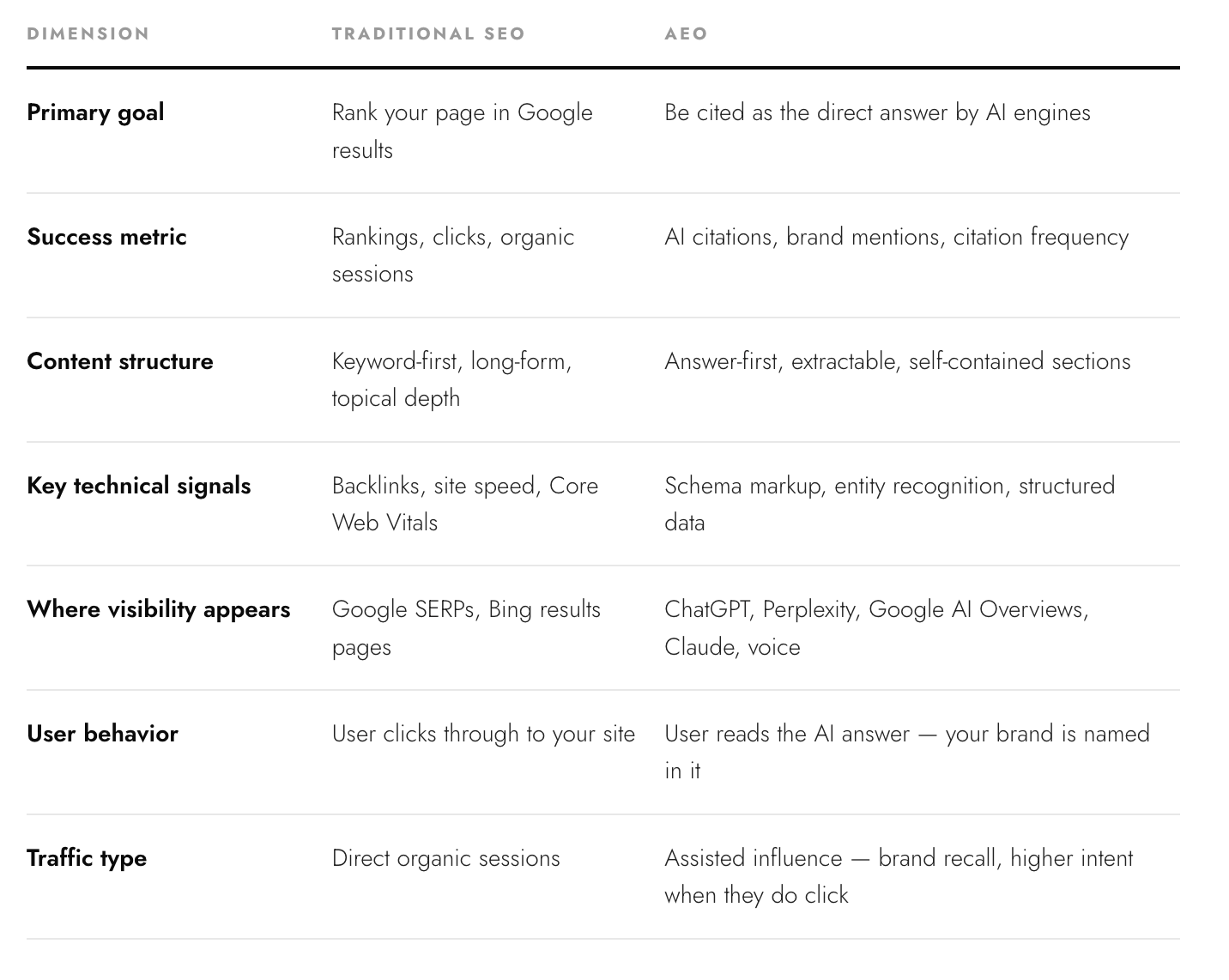
Why this matters specifically for DTC brands
DTC brands live and die by discovery. Unlike brands sold through department stores or major retail chains, you do not have shelf placement doing your visibility work. Every customer who finds you has to find you — through search, social, editorial, or word of mouth. AI search is becoming one of the primary discovery channels for consumer products, and most DTC brands have not built for it at all.
Consider the buying journey your customer is actually taking. She has heard about a category — UPF sun protection, clean skincare, functional wellness — and she wants to know what brand to trust. She does not Google "UPF hat brand" and scroll through results anymore. She asks ChatGPT. She asks Perplexity. She checks what shows up in Google's AI Overview before the organic links even load. The brands cited in those moments are setting the short list before she has visited a single website.
There is also a structural advantage here that small DTC brands can actually exploit. AEO rewards clarity and specificity over budget. A brand that answers a very specific question — what is the best UPF 40 sun hat made in Portugal — with clean content structure, correct schema markup, and consistent brand signals can outperform a large brand with massive domain authority that has never been optimized for AI citation. This is a level of playing field that traditional SEO almost never offers.
The conversion signal you need to know: AI-referred visitors convert at 4.4 times the rate of standard organic visitors and spend 68% more time on site. The volume is still building — but the quality of that traffic is already exceptional. Getting cited early builds the compounding authority that makes every subsequent citation more likely.
How AI engines decide who to cite
Understanding this is the entire game. AI answer engines are not returning the highest-ranking page. They are selecting the content that is clearest, most credible, and most structurally suited to extraction. Three signals drive citation selection above everything else.
1. Entity recognition
AI engines operate on entity graphs — they understand people, organizations, products, and concepts, and the relationships between them. For your brand to be cited, it needs to be a recognized entity. That means consistent naming across every surface (your site, your social profiles, third-party mentions), structured data (Organization JSON-LD on your homepage) that formally declares what you are and who you serve, and enough web presence that AI systems can build a confident picture of your brand identity.
2. Content extractability
AI systems pull individual chunks of content, not full pages. Every section of your product pages and blog posts needs to stand alone — to be legible and useful as a standalone excerpt. That means leading every page with a direct answer to its primary question in the first 60 words. It means using H2 and H3 headings written as natural questions ("What does UPF 40 mean?") rather than keyword-dense titles. It means short, tight paragraphs that can be lifted and cited without losing context.
3. Trust signals and authority
AI engines infer trust from the same signals Google uses — plus a few more. Author credentials matter. Publication recency matters. Consistency between what your site says and what third-party sources say about you matters. If your homepage says you are a DTC brand for outdoor living but your LinkedIn says you are a fashion accessories company, AI systems register that inconsistency as a credibility signal. Aligning every brand surface is not a branding exercise — it is an AEO one.
The five highest-leverage AEO moves for a DTC brand
If you are starting from zero, this is where to focus first. These five moves create the most surface area for AI citation in the shortest time.
Rewrite every page to lead with a direct answer. The first 40 to 60 words of every product page and blog post should directly answer the core question the page is about. No preambles. No scene-setting intros. Start with the answer, then expand. AI engines read the top of pages first — if the answer is buried three paragraphs down, the citation goes to a competitor who put it first.
Add FAQPage schema to every key page. FAQPage JSON-LD markup is one of the highest-impact AEO implementations available, because FAQ content maps directly to how users query AI engines. Mark up 4 to 6 question-answer pairs per page using the exact language your customer uses — not marketing language. Validate the schema with Google's Rich Results Test before publishing.
Add Organization schema to your homepage. Organization JSON-LD formally declares your brand's identity to AI systems. It should include your official name, URL, description, founder information, and sameAs links to your LinkedIn, Instagram, and any other authoritative external profiles. This is the single most important technical AEO action for a brand that does not yet appear in AI citations.
Publish category-level educational content. AI engines cite brands that answer category questions — not just brands that sell products. Create blog content that answers the actual questions your customer is typing into ChatGPT: what is UPF protection, how do I build a non-toxic skincare routine, what should I look for in a clean supplement brand. This content positions you as a trusted authority in your category, not just a product seller.
Audit your brand entity consistency across every surface. Your brand name, product descriptions, ingredient claims, category positioning, and founder credentials need to match exactly across your website, your social profiles, your press mentions, and any third-party directories. Any inconsistency is a credibility gap in the entity graph AI systems build around your brand. Close every gap you find.
How to know if AEO is working
AEO requires different measurement than SEO. You are not tracking rankings and clicks — you are tracking citations and mentions inside AI-generated responses.
The simplest place to start requires no tool budget at all. Choose 15 to 20 questions your customer would type into an AI tool about your category. Ask each of them in ChatGPT, Perplexity, and Google (check the AI Overview). Record whether your brand appears, which pages are cited when it does, and how your brand is described. Do this monthly and log your results. That baseline gives you a clear picture of your current AI visibility and a way to track progress as you implement AEO changes.
For more systematic monitoring, tools like Scrunch, SE Ranking's AI Search Toolkit, and HubSpot's AEO Grader track citation frequency, brand mention sentiment, and share of voice across AI platforms. These become essential once you are running AEO work for clients — or for your own brand at scale.
One pattern shows up consistently in AEO case studies: visibility shifts before traffic does. Brands begin appearing in AI citations weeks before they see meaningful AI referral traffic increases. That lag is actually useful — it is a leading indicator. If you see your citation rate increasing, traffic growth is coming.
Frequently asked questions
How is AEO different from SEO?
SEO optimizes your content to rank in Google search results and earn clicks to your website. AEO optimizes your content to be extracted and cited by AI answer engines — often without the user ever visiting your site. In AEO, success is measured in citations and brand mentions inside AI-generated responses, not page rankings. The two disciplines share a technical foundation but differ in content structure, measurement, and intent targeting.
Why does AEO matter for consumer brands right now?
Over 60% of Google searches now end without a click. ChatGPT handles over 2 billion queries daily. Gartner projects traditional search volume will drop 25% by end of 2026. For consumer brands, this means a growing share of the buying journey — product discovery, category research, brand comparisons — is now happening inside AI tools, not on your website. Brands not structured for AI citation are invisible at those moments.
Can a small DTC brand compete for AEO citations against larger brands?
Yes — and often more effectively. AEO rewards structural clarity and specificity over budget and domain authority. A small DTC brand that answers a very specific question with clean content structure, correct schema, and consistent entity signals can outperform a large brand that has never been optimized for AI citation. AEO is a structural discipline, not an ad spend competition.
How do I get my DTC brand cited by ChatGPT or Perplexity?
The highest-leverage steps: structure every product page and blog post to answer a specific question in the first 60 words; add FAQPage JSON-LD schema markup to key pages; add Organization schema to your homepage; publish category-level educational content that answers the questions your ICP types into AI tools; and audit your brand entity signals for consistency across every surface.
What is an AEO audit for a DTC brand?
An AEO audit is a structured analysis of how visible your brand currently is inside AI-generated answers. It covers whether your brand appears when consumers ask category questions in ChatGPT, Perplexity, and Google AI Overviews; what your content structure looks like to AI systems; whether your schema markup is present and correctly implemented; how consistent your brand entity signals are across the web; and what your highest-opportunity gaps are relative to competitors.
How long does AEO take to show results?
Initial AI citations typically appear within 2 to 4 months of implementing AEO best practices. Significant authority — where your brand is regularly cited as a primary source across multiple AI platforms — typically takes 6 to 12 months of consistent content publication. Importantly, AI visibility often precedes traffic increases: brands see citation gains before they see meaningful referral traffic spikes.
Do I need to stop doing traditional SEO to focus on AEO?
No. SEO is the infrastructure. AEO is the layer built on top of it. Research shows that 99% of URLs appearing in AI-generated responses also appear in the top 20 organic search results. You need both — but they require different content decisions and different measurement frameworks. The brands winning right now are the ones building visibility across both channels simultaneously.
Work with Sloane
Find out where your brand stands in AI search
Sloane's AI Presence Audit tells you exactly where your brand appears and disappears across in AI-generated answers, and what to do about it.
$3,000 flat — delivered within two weeks
On a budget? Download the How-TO AEO Guide and workbook here: https://stanstore.com/sosloane
Sloane
sosloane.com — AEO Strategy for Consumer Brands