How to Get Your Brand Cited by ChatGPT, Perplexity, and Claude
Your customers are not Googling anymore. They are asking ChatGPT what skincare brand to buy, asking Perplexity which supplements are actually effective, and asking Claude to recommend a fitness brand worth investing in. If your brand is not being cited in those answers, you are invisible at the moment of highest buying intent. Here is exactly what to do about it.
There is a lot of noise right now around AI SEO, AEO (Answer Engine Optimization), and GEO (Generative Engine Optimization). They are all pointing at the same problem: the search game has fundamentally changed, and most brands are still playing by 2019 rules.
At Sloane, we work with consumer brands to close the gap between where they are and where AI models are willing to cite them. This is the framework we use. It is not theory. It is what works.
First, Understand Why AI Cites Some Brands and Not Others
Large language models like ChatGPT, Perplexity, Claude, and Gemini do not crawl the web the way Google does. They are trained on massive datasets and then retrieval-augmented with real-time web searches. What gets cited is what the model considers authoritative, clear, and directly responsive to a question.
That means your brand's citation probability is determined by a very specific set of signals. It is not about follower count. It is not about how beautiful your website looks. It is about whether your digital footprint clearly and consistently answers the questions your buyers are asking.
KEY INSIGHT
AI models are answer machines, not discovery engines. They are not browsing for the best brand. They are retrieving the most credible answer to a specific question. Your job is to be the answer to the question your customer is already asking.
The 5 Signals That Drive AI Visibility
01 — Structured, Question-Based Content
AI models are trained to match queries to responses. If your website content is structured around the questions your customers are actually asking (not just keywords), you dramatically increase the chance of being retrieved as a relevant answer. This means FAQ sections with schema markup, long-form content with clear headers framed as questions, and product descriptions that answer "why does this work" rather than just "what this is."
02 — Third-Party Authority and Citation Volume
AI models weight sources that are themselves cited by other credible sources. Press coverage, editorial roundups, podcast mentions, and expert quotes are not just PR wins. They are citation signals that AI treats as trust indicators. If a Vogue editor mentions your brand in a best-of list, that signal gets ingested into training data and retrieval indexes. Your PR strategy is now also your AEO strategy.
03 — Entity Clarity Across the Web
AI models need to be able to clearly "understand" what your brand is, what category it belongs to, and what problem it solves. This requires consistent brand entity language across your website, social profiles, press mentions, Google Business Profile, and anywhere else you appear digitally. Inconsistency creates ambiguity. Ambiguity kills citation probability.
04 — Technical Schema and Structured Data
If your site does not have structured data markup, you are leaving significant AI visibility on the table. Organization schema, Product schema, FAQPage schema, and BreadcrumbList schema all help AI crawlers parse who you are and what you offer. This is table stakes for any brand serious about showing up in AI-generated answers.
05 — An llms.txt File
This is newer and still being adopted but it matters. An llms.txt file is a plain-text document in your site root that gives AI crawlers a clean, structured summary of who you are, what you sell, and what content you want indexed. Think of it as a handshake between your brand and the AI model reading your site. It takes about two hours to implement and the majority of your competitors have not done it yet.
"The brands showing up in AI answers are not necessarily the biggest brands. They are the clearest ones. The ones that made it easy for the model to understand and trust them."
What AEO Content Actually Looks Like
AEO content is not just blogging with keywords. It is a deliberate architecture of content that mirrors how AI models retrieve and surface information. Here is what that looks like in practice for a consumer brand:
Deep "What Is" and "How Does It Work" content that establishes category expertise. If you make a SPF product, you need to own the answer to "how does SPF actually protect skin" before you can win the answer to "what SPF product should I buy."
Comparison content that honestly positions your brand against alternatives. AI models frequently surface comparison-style answers, and brands that have produced clear, credible comparison content get cited more frequently.
Use-case content that matches specific buyer scenarios. "Best hat for a beach vacation with UV protection" is not just a blog title, it is the literal query a person might type into Perplexity. If you have a page that answers that question better than anyone else, you win the citation.
Founder and expert content that establishes a human voice with a point of view. AI models are trained to trust expertise signals. A founder who has published clear, credible content about their category becomes a citable authority, not just a seller.
Structured FAQs on every core page with schema markup. Not decorative FAQs. Real questions with complete, specific, accurate answers that someone would actually ask in a search prompt.
How to Audit Your Current AI Visibility
Before you build, you need to know where you stand. The simplest way to audit your AI visibility is to open ChatGPT, Perplexity, Claude, and Gemini and ask each one a version of the question your ideal customer would ask when looking for a brand like yours.
Write down: Are you cited? Is a competitor cited? What language is used to describe the category? What sources are being pulled? This is your baseline. Everything you build from here is closing the gap between your current position and the position of the brand being cited in your place.
QUICK AUDIT — TRY THIS RIGHT NOW
Go to ChatGPT and type: "What is the best [your category] brand for [your target customer]?" Then try: "What [your category] brands do experts recommend?" Then: "What should I look for when buying [your product type]?" If your brand name does not appear in any of those answers, you have an AEO gap that content alone can fix.
The Difference Between AEO, GEO, and AI SEO
If you have seen all three terms and are not sure which one applies to your situation, here is the honest answer: they are describing the same underlying shift with slightly different emphasis.
AEO (Answer Engine Optimization) focuses on getting your content retrieved as the answer to a direct question. It is most relevant for brands where the customer journey starts with a question ("what is the safest sunscreen?").
GEO (Generative Engine Optimization) is the broader academic framing and refers to optimizing for appearance in any AI-generated output, including summaries, comparisons, and recommendations.
AI SEO is the most common search term right now and tends to mean the full stack: technical implementation, content strategy, entity building, and third-party authority signals all working together to increase AI citation probability.
At Sloane, we use AEO as our primary framing because it centers the question, which is where all of this starts. The buyer has a question. The AI has an answer. Your brand either is that answer or it is not.
Where Most Brands Go Wrong
The most common mistake is treating AI search like a slightly different version of Google SEO. It is not. Keyword density, backlink volume, and domain authority are relevant inputs, but they are not the primary drivers of AI citation.
The brands that are getting cited consistently have one thing in common: they made it structurally easy for an AI model to understand exactly what they are, who they serve, and why they are trustworthy. That requires a different kind of content build than most brands have done. It requires structured content strategy, entity clarity, and technical signals working together, not just good blog posts.
The other mistake is waiting. The brands building AEO authority right now are establishing citation patterns that will compound over time. The longer you wait, the more ground your category competitors are covering while your brand stays invisible in AI-generated answers.
How to Start This Week
You do not need an agency retainer or a six-figure content budget to start building AI visibility. Here is what a focused founder or marketing lead can do in the next seven days:
Run the audit prompts above across ChatGPT, Perplexity, Claude, and Gemini. Document what you find.
Review your website's homepage and top product pages. Rewrite at least one section on each to directly answer a question your customer would ask.
Add a proper FAQ section to your homepage and top landing page with at minimum five questions and complete, specific answers.
Install FAQPage schema on those FAQ sections using a free schema generator or your platform's built-in schema tools.
Draft an llms.txt file for your site. It is a simple text document. You can create a basic version in under an hour.
Identify one editorial or press placement you could pursue this month. Pitch a real story with a real point of view, not just a product announcement.
That is six concrete actions that will move your AI visibility needle. None of them require an agency. All of them compound over time.
Want the Full Playbook?
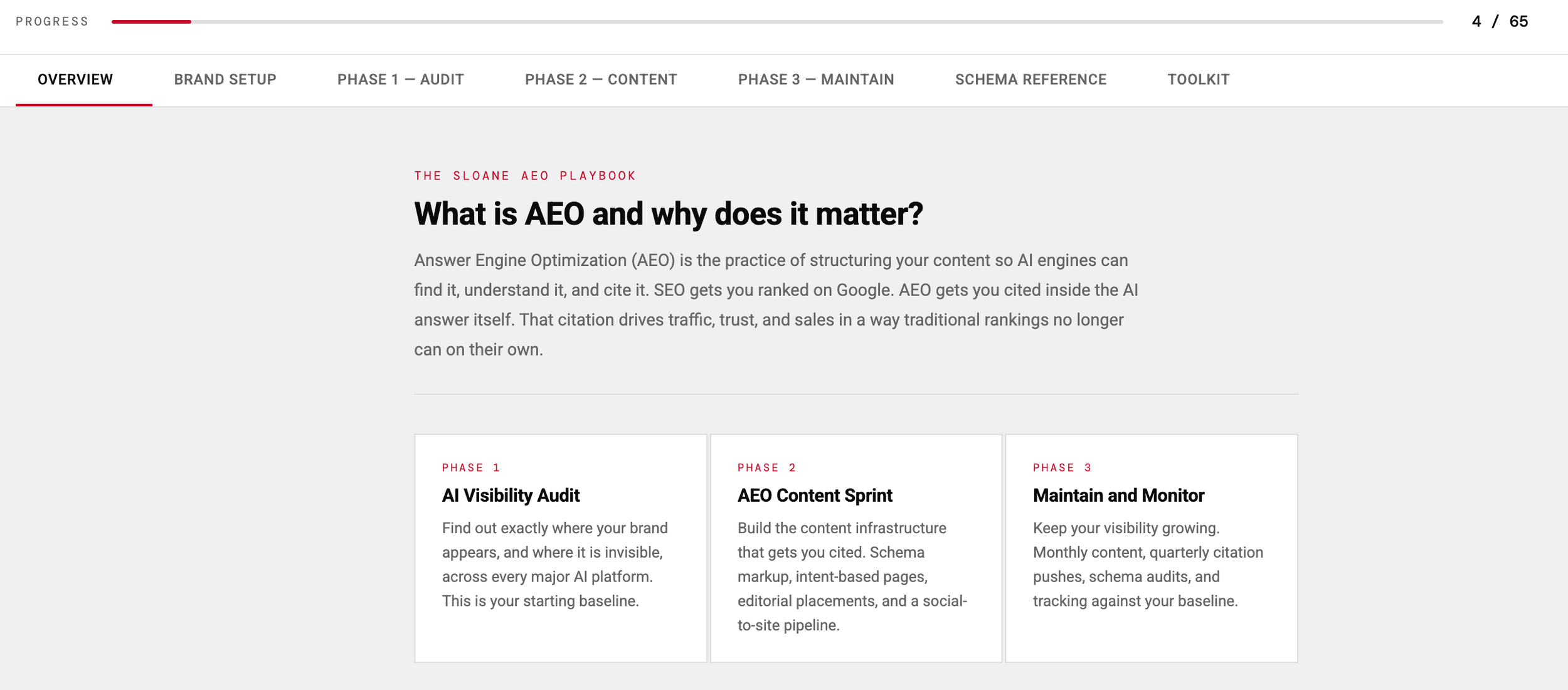
The Sloane AEO Playbook is a step-by-step guide for business owners, founders and marketers who want to build AI search visibility without hiring an agency. It covers the full framework: content architecture, technical setup, entity building, prompt testing, and the exact templates we use with clients. Built for consumer brands and busineses ready to own their AI footprint. Available now on Stan Store.