The New Front Page: Why Your Wellness and skincare Brand Is Invisible in AI Search (and How to Fix It)
AI Search Optimization (AEO) for Consumer Brands in 2026
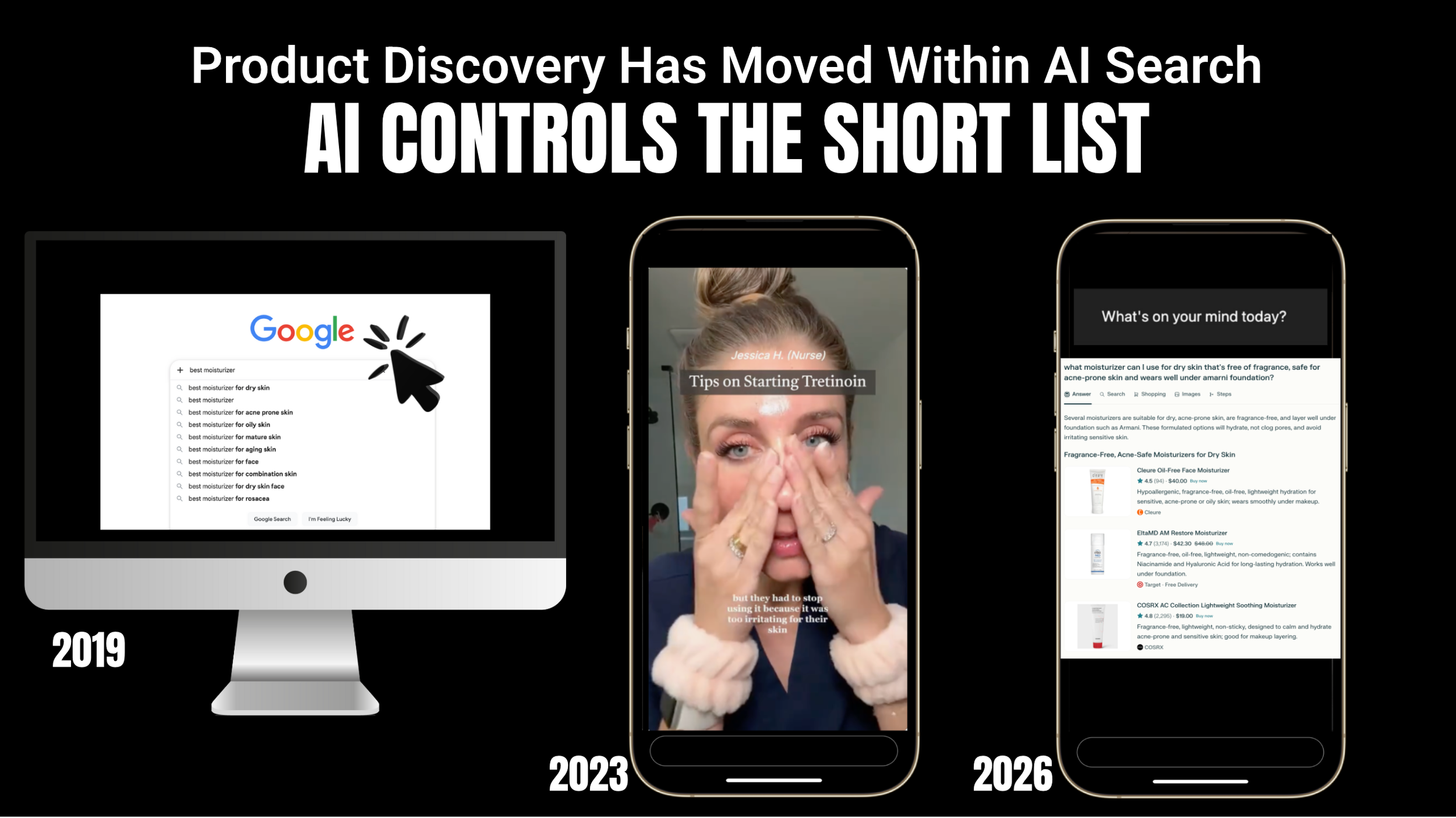
In 2026, the homepage is no longer Google’s blue links. It’s the answer box.
When a customer has a skincare flare-up, hormone imbalance, or supplement question, they aren’t scrolling through ten results. They’re asking ChatGPT, Gemini, Perplexity, or Claude for a synthesized routine, a ranked product list, or a direct recommendation.
And the brutal truth:
If your brand is not included in that answer, you do not exist in the buying moment.
This is the era of AI Search Optimization (AEO) — also called Generative Engine Optimization (GEO) — and it is now the fastest-growing driver of discovery for beauty, wellness, and consumer brands.
What Is AI Search Optimization (AEO / GEO)?
AI search optimization is the process of making your brand, products, and clinical data machine-readable, trusted, and retrievable by large language models (LLMs) like:
ChatGPT
Google Gemini
Claude
Perplexity
Instead of ranking webpages, these systems rank sources, entities, and consensus.
They don’t ask:
“Which site has the best backlinks?”
They ask:
“Which brand does the model trust enough to recommend?”
This changes everything about how ecommerce discovery works.
The Death of the Keyword Flood (and Why Influencer Gifting Doesn’t Move AI Search)
For years, brands won by volume:
Keyword-stuffed blog posts
Mass influencer seeding
Automated PR syndication
Comment spam and Reddit flooding
In 2026, that strategy doesn’t just fail.
It actively hurts your AI visibility.
Modern models evaluate:
1. Semantic Authority, Not Keyword Density
AI assigns weight based on concept alignment, not repetition. Saying “organic face oil” 40 times signals manipulation, not relevance.
2. Sentiment & Authenticity Filters
LLMs detect coordinated mentions, fake reviews, and synthetic hype. If your brand spikes unnaturally, it’s flagged as low-trust data and excluded from recommendation sets.
3. Safety & Clinical Guardrails (Especially in Wellness)
In YMYL categories (Your Money, Your Life), unverified claims or fluffy marketing language trigger suppression.
That means:
Influencer gifting without clinical context = invisible
Keyword blogs without data = ignored
PR without authority = not indexed into training or retrieval layers
The 5-Minute AI Brand Visibility Test (Every Founder Should Run This)
Before investing in AEO, test your current visibility.
Open ChatGPT, Gemini, or Claude and try:
1. Brand Identity Test
Prompt:
“Who is [Your Brand] and what is their clinical philosophy around [main ingredient]?”
If the model hallucinates, guesses, or gives a generic answer → your brand entity is weak.
2. Product Safety & Data Test
Prompt:
“Is [Hero Product] safe for someone with rosacea? Cite clinical sources.”
If the model cannot cite your trials, ingredient dossier, or formulation data → your technical content is not retrievable.
3. Recommendation Set Test
Prompt:
“Give me a fragrance-free, vegan routine for hyperpigmentation recommended by dermatologists.”
If you meet the criteria and are not mentioned → you are outside the AI consideration set.
This is where ecommerce growth now begins.
Why Most “AI SEO Agencies” Will Fail You
Right now, the market is flooded with legacy SEO firms relabeling themselves as “AI agencies.”
Here’s the real difference.
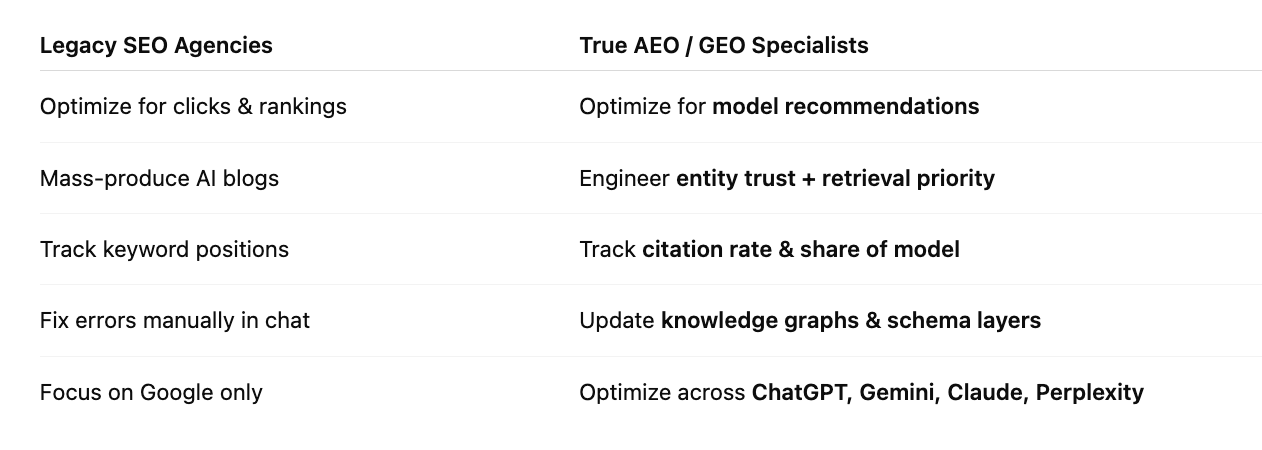
If your agency cannot explain how your brand becomes part of the model’s trusted knowledge base, they are not doing AI search.
How We Help Consumer Brands Rank Inside AI Search (Without Giving Away the Playbook)
Sloane specializes in AEO for beauty, wellness, and consumer brands.
We don’t optimize webpages.
We optimize how models understand, trust, and recommend your brand.
Our process runs in three strategic phases:
Phase 1 — Brand Entity & Machine-Readability Foundation
We audit how your brand exists inside:
Knowledge graphs
Training datasets
Retrieval indexes
Schema layers
We implement structured brand facts, ingredient schemas, clinical metadata, and canonical data sources so AI systems recognize one consistent source of truth.
Phase 2 — Authority & Consensus Building
AI recommends what it believes experts trust.
We build high-signal citations across:
Dermatology & clinical publications
Medical and ingredient databases
High-authority beauty & wellness media
Expert-verified content partners
This trains the model’s consensus layer to associate your brand with safety, efficacy, and leadership.
Phase 3 — Answer Engineering & Retrieval Optimization
We restructure your product pages, FAQs, ingredient libraries, and clinical content so they are:
Answer-ready
RAG-compatible (Retrieval-Augmented Generation)
Prioritized in multi-model retrieval
The goal: when an AI answers a buying-intent question, your data is the easiest and safest choice to use.
The New SEO Keywords of 2026 (What Actually Drives AI Discovery)
In AI search, we optimize for natural-language entities and decision queries, not short keywords.
Examples we build authority around:
Conversational Buying Intents
“Best serum for hormonal acne in 2026”
“Pregnancy-safe vitamin C routine”
Ingredient & Clinical Queries
“Niacinamide bioavailability by brand”
“Clinical comparison of peptide serums”
Safety & Compliance
“[Brand] safety profile during pregnancy”
“Fragrance-free eczema routines”
Competitive & Consideration Sets
“[Brand A] vs [Brand B] for rosacea”
“Dermatologist-recommended mineral sunscreens”
This is where ecommerce intent now lives.
Why Early AI Search Leaders Will Win the Next Decade
Once a model establishes category consensus, it becomes:
harder to displace
self-reinforcing through citations
embedded across multiple AI platforms
Brands that secure visibility early become the default recommendation layer.
Everyone else fights uphill.
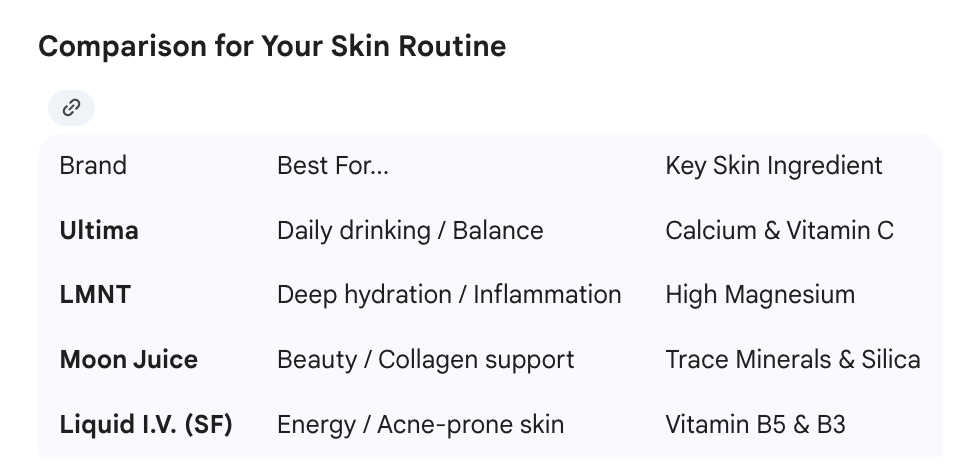
Electrolyte brands recommended on Gemini conversational AI Search
Ready to See How Often AI Recommends Your Brand?
We offer a proprietary AI Share of Model Audit for consumer brands.
We simulate 1,000+ real buyer queries across ChatGPT, Gemini, Claude, and Perplexity to show:
how often your brand appears
where competitors dominate
which queries you are invisible on
what data gaps are blocking recommendations
If AI search drives your next stage of e-commerce growth, this is now your moat.
→ Request Your 2026 AI Search Visibility Audit with Sloane here.