Social Search Optimization: The Marketing Skill Most Brands Are Still Ignoring
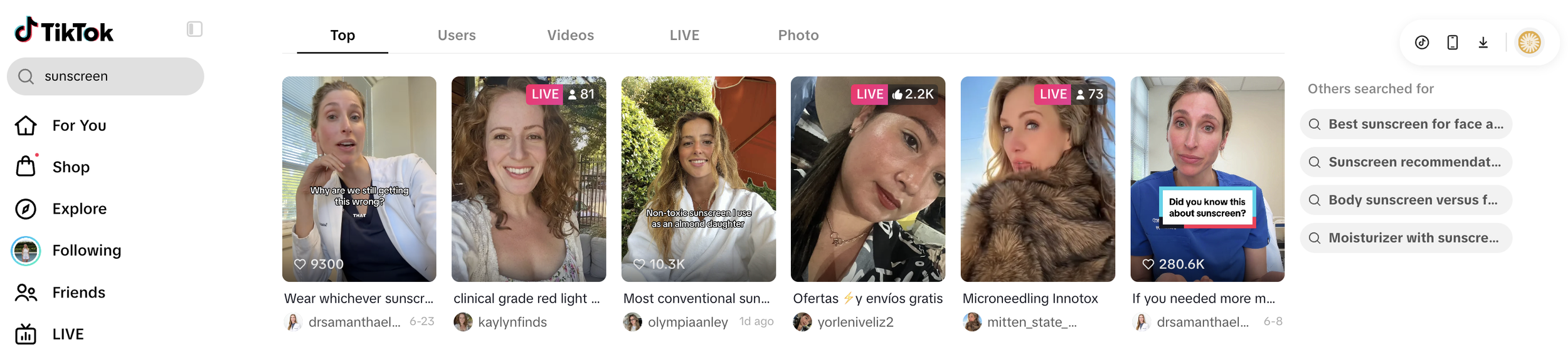
SSO - Social Search Optimization on TikTok
Your customer isn't opening Google first anymore. She's opening TikTok.
They’re typing "best retinol for beginners" into the search bar, not the caption field. They’re searching Instagram for a restaurant before she searches Google. They’re using YouTube to compare two products before she ever hits a brand's website. This is social search, and most brands are still building content for the feed instead of the search bar.
That gap has a name: social search optimization, or SSO.
What is social search optimization
Social search optimization is the practice of building content so it ranks inside a platform's native search results, not just its algorithmic feed. It applies to TikTok, Instagram, YouTube, and increasingly Pinterest, anywhere a user can type a query and expect a relevant answer back.
This is a different job than getting reach. A video can perform well in the feed and still be invisible in search if it isn't built around the language people actually type. SSO is about matching that language on purpose.
The shift happened because the platforms themselves changed function. TikTok and Instagram stopped being pure discovery feeds and became places people go to research, compare, and decide. Once that happened, search became a real surface with its own ranking logic, separate from the algorithm that decides what shows up while you scroll.
How SSO actually works
Social platforms rank search results using a mix of text and behavioral signals. The main ones:
Captions. Your keyword needs to live in the first line, before the caption truncates. If the topic isn't stated plainly and early, the platform has less to work with.
On-screen text and spoken audio. Both TikTok and Instagram transcribe audio automatically to classify content. Saying your keyword out loud in the first few seconds, and reinforcing it with text on screen, gives the platform a clean signal about what the video is actually about.
Hashtags. Specific beats generic. A hashtag describing your exact topic does more work than a broad, high-volume tag that a million other posts are also using.
Profile. Your username, display name, and bio are searchable text, not just branding. Treat them like on-page SEO: clear, keyword-aware, and honest about what you actually do.
Engagement. Watch time, saves, shares, and comments still influence whether content surfaces in search, the same way they influence the feed. Search doesn't override the algorithm, it adds a second lens on top of it.
None of this works as a checklist you fill out once. It's a habit you build into how you script, caption, and tag every piece of content going forward.
SSO vs. traditional SEO
SEO and SSO share a discipline. Both reward content built around real search intent instead of content built purely to be liked or shared. Both use keywords, structure, and metadata as ranking inputs.
The difference is where that content lives and how it's read. SEO ranks a webpage on a search engine results page, driven heavily by text, site structure, and backlinks. SSO ranks a video or post inside a platform's native search, driven heavily by transcribed audio, on-screen text, and short-form engagement behavior.
Practically: a strong SEO strategy and a strong SSO strategy are not separate departments. They're the same instinct, applied to different formats. If your team already thinks in keywords and search intent for your website, that same thinking transfers directly to your TikTok and Instagram content, it just needs different execution.
SSO and AI search
There are two more acronyms worth knowing, because they're closely related and increasingly show up in the same conversation: AEO and GEO.
AEO (answer engine optimization) is the practice of structuring content so it gets pulled into featured snippets, zero-click answers, and AI-generated overviews.
GEO (generative engine optimization) is the practice of building authoritative, well-structured content that generative AI tools cite directly in their synthesized responses.
The three disciplines rank content in three different places: SEO ranks a page, AEO/GEO earns a citation inside an AI-generated answer, and SSO earns placement inside a platform's native search. But the underlying content principle is the same across all three: answer the question directly and clearly, then build out the depth around that answer. Content built only to maximize reach or engagement doesn't perform as well in any of the three, because none of them are optimizing for reach. They're optimizing for being the correct, extractable answer.
This means brands don't need three separate content strategies for SEO, AEO, and SSO. They need one strategy built on direct, well-structured answers, produced in the right format for each surface.
Why this matters right now
Search behavior has shifted faster than most marketing teams have. Younger audiences increasingly start product research on TikTok or Instagram before they ever open Google. Most brands are still building for the old model: content optimized for reach and impressions, not for being found when someone is actively looking.
That gap is the opportunity. The ranking factors behind social search are becoming well understood. Most brands haven't adjusted their content process to account for them yet. The brands that build this into their process now get a real head start, not because the tactics are secret, but because so few teams are executing on them consistently.
How to build an SSO strategy
Audit what's already working. Check TikTok and Instagram's native analytics for the search terms already sending you traffic before you create anything new.
Identify real queries, not guessed hashtags. List 5 to 10 things your customer actually types when she's looking for what you sell.
Rebuild your hook and caption structure around those queries. Keyword in the first line of the caption, spoken out loud in the first three seconds of the video.
Treat your profile as searchable copy. Your bio and display name should say plainly what you do, in the language your audience searches.
Track what starts showing up in search, and repeat it. Once you see which format and topic combination ranks, build more of exactly that.
This isn't a one-time project. It's a shift in how your team scripts and captions every piece of content, permanently.
The bottom line
Search didn't disappear. It moved. It's inside TikTok, inside Instagram, inside the AI overview at the top of a Google page. Brands that keep building only for reach are optimizing for a version of discovery that's shrinking. Brands that build for search, on every surface where their customer is actually searching, are the ones that get found.
FAQ
What does SSO stand for? Social search optimization: the practice of optimizing content so it ranks in a platform's native search results, not just its algorithmic feed.
Is social search optimization the same as SEO? No. SEO ranks webpages on search engines. SSO ranks content inside platforms like TikTok and Instagram. They share the same underlying discipline of matching real search intent, but the execution and ranking signals are different.
Which platforms does social search optimization apply to? Primarily TikTok and Instagram, with growing relevance on YouTube and Pinterest, anywhere a platform has a native search function.
How is SSO different from AEO? AEO (answer engine optimization) is about earning placement in AI-generated answers and featured snippets. SSO is about ranking inside a social platform's own search bar. Both reward direct, clearly structured content, but they target different surfaces.